Read the topics, tasks, questions, signals, and judged outcomes from Assistant Cloud analysis.
Intelligence turns analysed conversations into a view of what people ask for and where the assistant falls short. It is a reading page: choose the range, inspect the evidence, then follow any figure into the matching Threads list. Configure the worker, provider, and classifier rules in Intelligence settings.
What the page answers
The page opens on the last 28 days. Its header identifies the conversations covered by that range and the most recent analysis run, so compare a figure only with the coverage shown beside it. The date range stays with every drilldown.
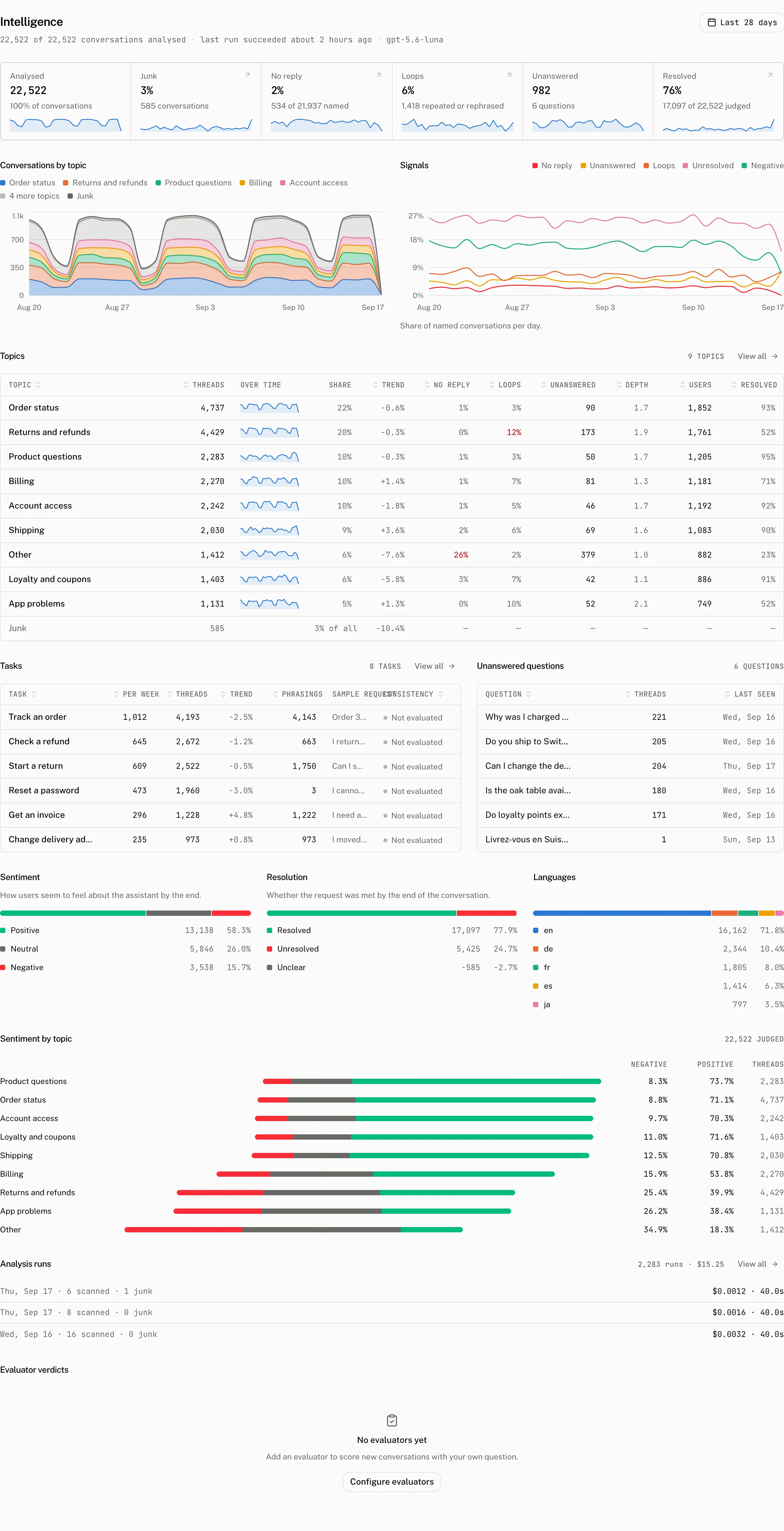
The six tiles
| Tile | What it counts |
|---|---|
| Analysed | Conversations the analysis passes processed in the selected range, junk included. |
| Junk | The share of the conversations the pass scanned that it stored as junk and left out of model classification, with their count. |
| No reply | Named conversations with no assistant messages. |
| Loops | Named conversations with an exact repeat or a rephrased turn. |
| Unanswered | Conversations with an unanswered question. |
| Resolved | Conversations whose analysis records a resolved outcome. |
Conversations by topic puts the analysed conversation count into the selected date buckets by topic. Signals puts the no reply, loop, unanswered, sentiment, resolution, and depth readings into those buckets, so a change can be located before opening the rows behind it.
Reading the Topics pivot
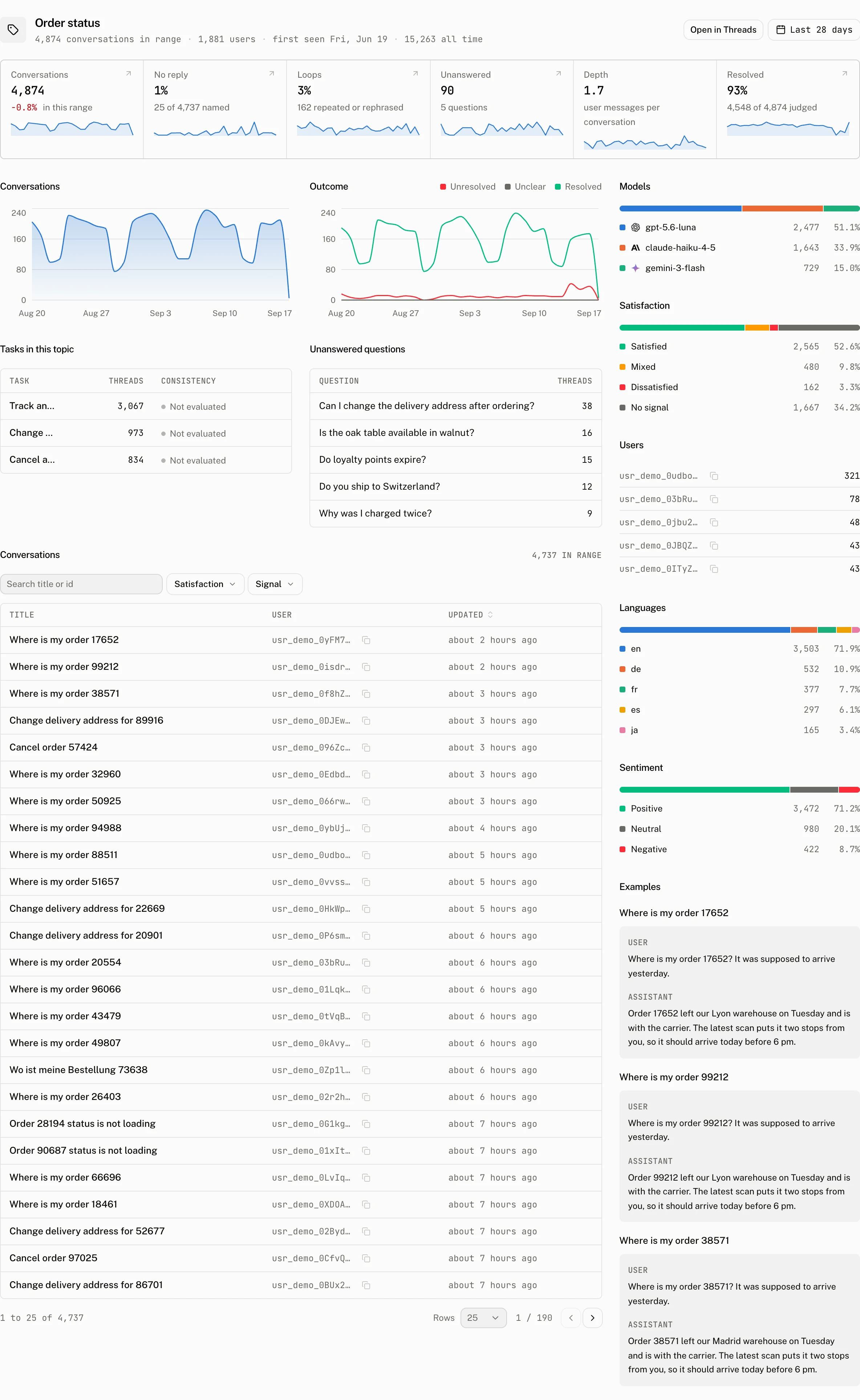
The Topics table is the compact comparison of the named conversation groups. Open a topic to read that topic over the active range.
| Column | Reading |
|---|---|
| Threads | The conversations assigned to the topic. |
| Share | The share reading for the topic. |
| Trend | The topic's trend reading, when the table has one. |
| No reply | Named conversations in the topic with no assistant messages. |
| Loops | Conversations in the topic with an exact repeat or a rephrased turn. |
| Unanswered | Conversations in the topic with an unanswered question. |
| Depth | The mean number of user messages in the topic's conversations. |
| Users | The Users reading for the topic. |
| Resolved | The Resolved reading for the topic. |
A rate that stands out from the page's own mean is shown in its outcome's color, so the row that needs attention is found without a flag column. A blank Trend cell has no trend reading.
Tasks, questions, and judged outcomes
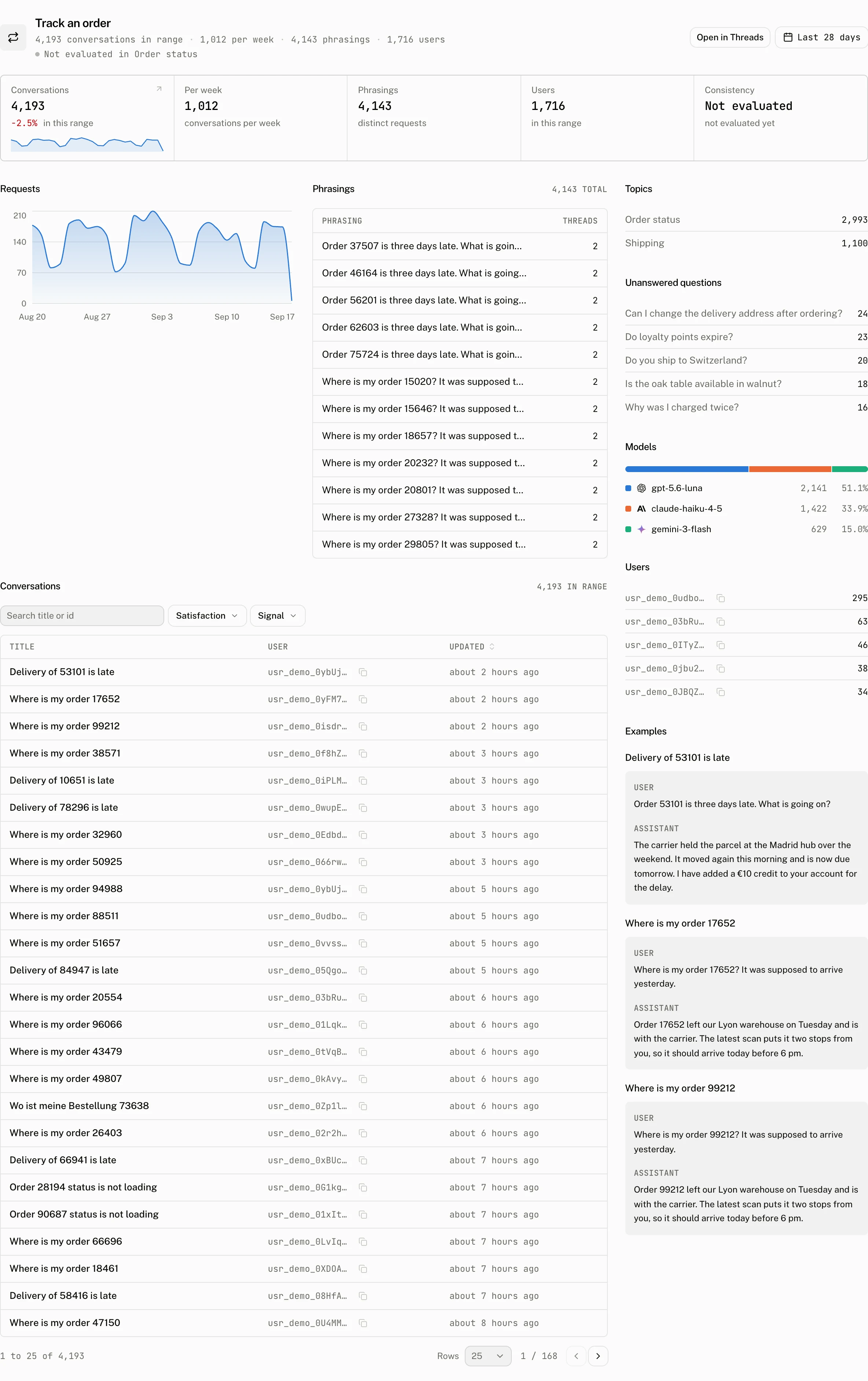
Tasks groups repeated requests. Its consistency reading is Consistent, Mixed, or Inconsistent. Open a task to inspect it in the current range. The task page is the one place that offers Create skill: it links that task to an assistant, so the project can retain the association.
Unanswered questions lists the questions identified by the classifier, with the selected range still in effect. Sentiment by topic compares the topic groups, while the judged mix below it separates Sentiment, Resolution, and Languages. Sentiment is positive, neutral, or negative. Resolution separates resolved and unresolved conversations. Languages is the language mix reported by analysis.
Evaluator verdicts shows the evaluator results alongside the analysis. Any judged section that has not received a result reads Not judged yet and explains After the next analysis run.
Follow a figure to the conversations
Every Intelligence figure is a route into Threads. The link keeps the page's date range and adds the matching filter, which makes the table the evidence behind the count.
| Figure or detail | Threads filter |
|---|---|
| Topic or topic page | topic |
| Task or task page | task |
| Unanswered question | question |
| Junk | junk |
| Sentiment | sentiment |
| Resolution | resolved |
| Language | language |
| No reply | signal=no_reply |
| Loops | signal=loop |
Threads can combine these with the other filters in its bar. In particular, Ended on the user's message is the separate unanswered filter; it is not the same reading as the analysis's unanswered question signal.
Detail pages and runs
Opening a topic uses the active date range to show that topic's reading and its related Threads. Opening a task does the same for the task, its consistency, and its linked skill when one exists. The task's Create skill action connects the task to an assistant; it does not create a second task category.
Analysis runs is the ledger for the work behind the page. The summary retains the latest 3 runs and their aggregate run count, failed count, cost, and tokens. All runs opens the runs page, which paginates the analysis-run ledger 50 records at a time. A run row records the day, scanned conversations, junk count, model, and either its cost or status. The settings page's Run now and Re-analyse last 28 days controls queue this work; the worker passes every hour and takes queued requests first.
When the page has no answer yet
Intelligence is available on paid plans. Without it, the page reads: Intelligence requires a paid plan. Upgrade on the Billing page to unlock topic analysis for this project.
Before the first completed analysis, the page reads: No analysis yet. The analysis runs every hour on the provider chosen in Settings; its topics, tasks and signals appear here after the first run.
Troubleshooting
| What you see | Why | What to do |
|---|---|---|
| A topic is missing | The conversation may be classified as junk, or the configured topic ceiling folded new conversations into Other. | Check the conversation in Threads with the Junk filter, then review the classifier settings. |
| A topic has no trend | The table has no Trend reading for that topic. | Compare the topic after later analysis runs. |
| A task has no skill | A task and an assistant skill are linked only after Create skill is used on that task. | Open the task and create the link. |
| Evaluator verdicts are empty | The section has not been judged yet. | Read the After the next analysis run state, then inspect the analysis-run ledger. |